Telehealth News: 2026 Developments for Healthcare Leaders
For healthcare leaders, the most consequential telehealth news in 2026 concerns policy duration, reimbursement visibility, interoperability guidance, virtual nursing, and remote clinical collaboration. The practical challenge is to separate durable requirements from temporary extensions, then turn each development into an owned decision about governance, workflows, staffing, security, and revenue cycle.
The 2026 telehealth environment is a planning window, not a reason to stop reviewing policy. HHS and CMS describe temporary Medicare flexibilities through December 31, 2027, while some behavioral health provisions are permanent. Leaders should connect every policy change to a documented workflow, responsible owner, source date, effective date, and review date.
This article is an operational briefing, not legal, reimbursement, or clinical advice. Confirm current requirements with CMS, HHS, compliance counsel, state regulators, and applicable payers before changing care delivery or billing workflows.
What does telehealth news show about Medicare policy in 2026?
Current Medicare telehealth policy combines temporary access extensions with permanent behavioral health provisions. HHS says several non-behavioral and non-mental health flexibilities continue through December 31, 2027, while leaders must still track practitioner, service, documentation, and payer-specific requirements.
The HHS telehealth policy update is the primary source for the current federal picture. It describes home-based Medicare telehealth for non-behavioral and non-mental health services through December 31, 2027, with no originating-site geographic restrictions during that period. It also identifies continued eligibility for Medicare providers and temporary audio-only provisions, subject to the applicable rules.
The American Medical Association reported on February 24, 2026, that the Consolidated Appropriations Act, 2026 renewed Medicare telehealth coverage for two years. That report is useful context for the policy timeline, but it does not replace the official HHS or CMS requirements that govern a particular service.
Which provisions are temporary, and which are permanent?
HHS separates temporary non-behavioral and non-mental health flexibilities from permanent behavioral health changes. For governance teams, that distinction matters because a workflow can remain operationally useful while its reimbursement or access assumptions change later.
- Mark every workflow that depends on a provision ending December 31, 2027.
- Record the source, effective date, sunset date, and accountable policy owner.
- Separate federal Medicare requirements from commercial-payer and state requirements.
- Schedule a review before the sunset date, not after a claim or service is affected.
FQHCs and RHCs, audio-only services, behavioral health, and practitioner eligibility each have specific conditions. A service label such as telehealth is not enough to establish coverage. The organization should document the patient location, practitioner type, payer, modality, service category, and supporting policy source for every material workflow.
Why should leaders keep reimbursement and quality reporting on the watchlist?
Reimbursement continuity supports planning, but it does not eliminate the need for coding controls or quality-reporting review. CMS updates the Medicare telehealth service list through annual rulemaking, and its 2026 eCQM guidance warns that telehealth eligibility for a measure does not make every code or numerator action telehealth-eligible.
The CMS Medicare telehealth page explains that additions and deletions to the telehealth services list take effect on January 1. CMS generally publishes the proposed Physician Fee Schedule rule in the summer and the final rule by November 1. That calendar gives finance, compliance, clinical operations, and IT a recurring point at which to review service catalogs and workflow assumptions.
The CMS telehealth FAQ updated February 26, 2026, also describes practitioner and beneficiary rules that change after 2027. For example, the FAQ identifies practitioner restrictions beginning January 1, 2028, and explains that coverage rules differ by service and setting. Teams should read the current FAQ with the applicable fee schedule, payer policies, and their own compliance review.
CMS guidance for 2026 electronic clinical quality measures adds a second operational signal. The 2026 telehealth eCQM guidance lists measures with telehealth-eligible encounter codes while noting that a qualifying encounter code does not guarantee that every code in a value set is eligible or that the quality action can be completed remotely.
| Planning question | Owner to involve | Evidence to retain |
|---|---|---|
| Which services are covered, and until when? | Finance and compliance | Current CMS, HHS, and payer guidance |
| What data and documentation accompany the encounter? | Clinical operations and IT | Workflow map and data-source inventory |
| Which measures can include the encounter? | Quality and reporting | Current eCQM specifications and code review |
| How are exceptions reviewed? | Revenue cycle and compliance | Escalation path, audit sample, and decision log |
Imaging adds another layer because a virtual encounter may depend on DICOM studies, patient context, and an authoritative clinical record. Teleray’s guide to reimbursement and coding for telehealth image sharing provides an internal reference for teams mapping these workflows. Technology can make information available, but it cannot decide whether a claim or clinical action is supported.
How is interoperability shaping telehealth operations?
Interoperability is an operating discipline, not just an interface project. Healthcare leaders need to know what clinical context moves with an encounter, which system remains authoritative, how identity is matched, and how the organization can demonstrate that information moved through a governed workflow.
The Office of the National Coordinator for Health Information Technology published the 2026 Interoperability Standards Advisory Reference Edition on March 10, 2026, and the page notes updates through June 9, 2026. The reference edition helps organizations assess standards and implementation specifications across clinical care, public health, research, and administrative use.
What should an interface governance team document?
For each telehealth workflow, document the required data elements, source system, receiving system, identity-matching method, access permissions, retention rule, error path, and accountable owner. This is especially important when scheduling, electronic records, virtual care, imaging, and quality reporting systems all participate in one encounter.
Organizations evaluating ways to image-enable an EMR without rebuilding the workflow should ask whether the design preserves patient context and keeps staff from reconstructing information across disconnected tools. A technically connected interface is not automatically an operationally governed one.
Why does data quality matter for reporting?
Telehealth leaders should test the handoff from scheduling to encounter, encounter to clinical record, and clinical record to reporting. A short pilot with defined audit questions can reveal whether an integration is useful in practice. Useful questions include whether timestamps are reliable, whether the encounter type is captured consistently, and whether an exception reaches the right owner.
What does virtual nursing news mean for hospital operations?
Virtual nursing is best treated as a governed operating model rather than a video feature. The central questions are what work the remote team may perform, what remains local, who has escalation authority, what documentation is required, and how the hospital will measure adoption and exceptions.
Hospitals are evaluating remote support for work such as admission history, discharge education, rounding assistance, observation, and escalation support. The appropriate scope depends on patient population, unit design, staffing, clinical policy, labor requirements, and local risk controls. A report from another health system can provide a useful example, but it does not establish a universal clinical or staffing model.
How should leaders define a virtual nursing program?
- Define the tasks the remote team may perform and the tasks that must remain with local staff.
- Document escalation triggers, handoffs, downtime procedures, and the person with decision authority.
- Map the patient context, devices, images, records, and permissions needed for each task.
- Set measures for response time, completion, exceptions, documentation quality, staff adoption, and patient experience.
- Review the model with nursing leadership, compliance, IT, and frontline clinicians before expansion.
Teleray’s virtual care and telesitting capabilities are relevant to organizations evaluating connected remote-support workflows. Any deployment still requires the healthcare organization to define clinical responsibility, role-based access, escalation, privacy, and oversight. The platform does not replace clinical judgment or local policy.
Where does remote clinical collaboration fit in the next phase of telehealth?
Remote clinical collaboration can mean a specialist viewing a live modality, guiding a local technician, or communicating with a care team during a procedure. This Teleray use case is different from generic at-home physiological monitoring because the value comes from coordinated clinical work and shared context in real time.
In an imaging setting, a remote specialist may need to see live ultrasound, CT, MRI, or other modality output while communicating with the local technician and care team. The workflow should make the image source, patient identity, participants, and handoff visible to authorized users. It should also define what happens when the connection fails, the study is incomplete, or the specialist cannot provide the requested interpretation.
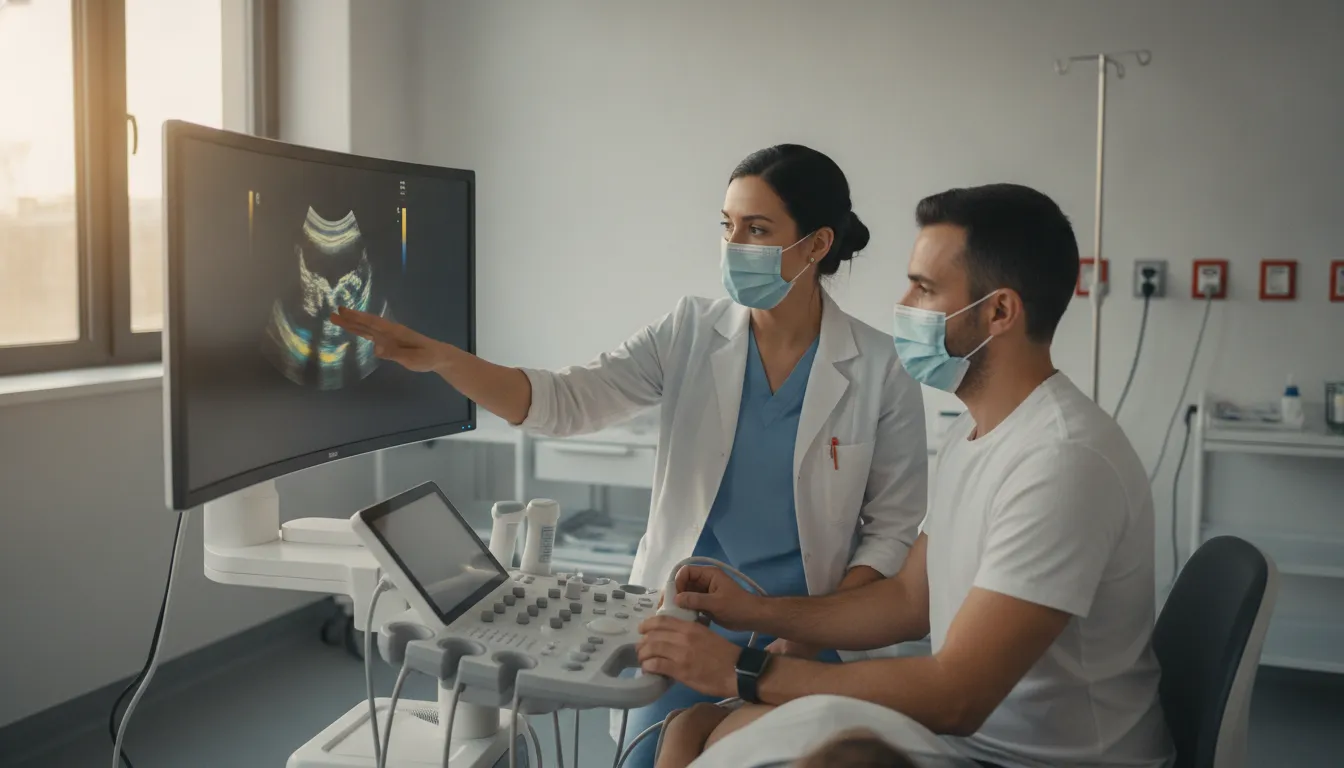
Teleray’s teleradiology and medical imaging platform materials describe workflows that connect remote specialists with clinical teams and imaging data. Teleray Live supports live modality streaming so an authorized specialist can participate during the examination, while the organization defines its own interpretation, documentation, and clinical governance requirements.
The broader architectural question is whether virtual care, imaging, and patient monitoring preserve context across one connected workflow. Teleray’s applicable diagnostic-viewing solution is FDA 510(k)-cleared; that clearance does not replace clinical judgment, organizational policy, or the need for appropriate oversight. A unified platform can simplify the technology decision, but it does not remove the need for HIPAA compliance, SOC 2 Type II controls, or access governance.
What should healthcare leaders do with this telehealth news?
Healthcare leaders can turn a fast-moving telehealth news cycle into a manageable governance routine by assigning owners and review dates. The goal is to make policy, interoperability, virtual nursing, and remote collaboration decisions traceable instead of leaving them as disconnected headlines.
- Policy: Record temporary and permanent provisions separately, including the source, effective date, and sunset or review date.
- Coverage: Compare Medicare guidance with commercial-payer, state, and organization-specific requirements.
- Workflow: Map scheduling, encounter, documentation, imaging access, escalation, and reporting.
- Security: Review identity matching, role-based access, encryption, retention, and audit logging.
- Operations: Assign owners for staffing, escalation, downtime procedures, and frontline training.
- Measurement: Monitor completion, exceptions, response times, documentation quality, and patient or staff feedback.
- Architecture: Prefer connected workflows that preserve clinical context instead of adding isolated tools without an ownership model.
Review the register monthly and run a deeper operating review quarterly. Before changing a workflow, verify the current source, confirm the effective date, consult the accountable clinical and compliance owners, and test the change with the people who will use it.
Frequently Asked Questions
How long do the current Medicare telehealth flexibilities last?
Several Medicare non-behavioral and non-mental health telehealth flexibilities, including home-based care and the absence of originating-site geographic restrictions, are authorized through December 31, 2027. HHS distinguishes these temporary provisions from permanent behavioral health changes. Confirm the current service, practitioner, documentation, and payer requirements before changing operations.
What did the 2026 interoperability guidance change?
The ONC 2026 Interoperability Standards Advisory Reference Edition organizes standards and implementation specifications for healthcare stakeholders and reflects updates made through 2025, with the page updated June 9, 2026. It is a reference for evaluation, not a substitute for workflow governance, identity controls, or implementation testing.
What can virtual nursing reporting tell a hospital planning team?
Reports from other hospitals can show how teams define remote nursing work, escalation, staffing, measurement, and sustainability. They do not establish a universal clinical model. A hospital should use them as examples, then validate scope, authority, patient population, documentation, labor requirements, and safety controls in its own environment.
How is remote clinical collaboration different from consumer remote monitoring?
Remote clinical collaboration can involve a specialist reviewing live modality output, guiding a local technician, or communicating with a care team during a clinical workflow. It is not limited to at-home physiological devices. The appropriate technology, privacy controls, and clinical governance depend on the use case and the organization’s policies.
Plan the next step in your telehealth strategy
Telehealth policy, interoperability, virtual nursing, and remote clinical collaboration are connected operating decisions. Teleray brings virtual care and medical imaging workflows together in a HIPAA-compliant platform for healthcare organizations evaluating secure access, connected clinical context, and integration simplicity. Discuss your current workflow, governance priorities, and integration requirements with the Teleray team.