
Virtual nursing in hospitals is a care-delivery model in which nurses use secure communication technology to support selected patient-care tasks from a remote clinical workspace. The hospital defines which interactions can happen virtually, which require a bedside clinician, and how the two roles coordinate. A useful program is not simply a video connection: it is a clearly bounded workflow, with accountable nursing judgment, appropriate escalation, and a reliable fallback when technology or patient needs make remote support unsuitable.
What Does Virtual Nursing Mean in a Hospital?
Virtual nursing generally describes nursing support delivered through a secure technology connection when the nurse is not physically in the patient’s room. The remote nurse may connect by live video or another approved communication method, while bedside staff remain responsible for tasks that require physical presence. The exact division is set by each organization’s policies, scope-of-practice requirements, patient population, staffing model, and clinical leadership.
It is important to define this term narrowly. Virtual nursing is not automatically the same as outpatient telehealth, remote physiological monitoring at home, or a replacement for bedside nursing. In a hospital, the question is how an additional nurse, working remotely, can fit into an existing inpatient team and support appropriate interactions without creating unclear handoffs or duplicate documentation.
Research on virtual nursing is still developing. An Agency for Healthcare Research and Quality PSNet summary describes virtual care mechanisms such as remote triage and video consultation, and discusses the effects of virtual nursing and missed nursing care. A 2025 report in PubMed Central found mixed staff perceptions: most nurses surveyed did not feel virtual nursing reduced workload, while slightly more than half said it improved care quality. These are staff-reported views, not proof that a particular model improves outcomes in every hospital. They reinforce the need to define the local use case and measure it rather than assume a benefit. Read the AHRQ PSNet summary and review the virtual nursing study.
Which Hospital Workflows Can a Virtual Nurse Support?
Begin by identifying work that can be supported through a conversation, observation, or coordination step, while preserving clear ownership for hands-on care. The aim is not to label tasks “virtual” in the abstract. It is to determine whether a remote nurse can perform a specific part of the workflow safely, with the right information and a timely route to bedside assistance.
- Patient orientation and education: A remote nurse may conduct or reinforce approved explanations, confirm understanding, and direct questions requiring an in-person assessment to the bedside team.
- Admission or history-taking support: A hospital may use a remote nurse to gather information or complete defined portions of an intake, if local policy permits and staff can resolve discrepancies.
- Care-plan communication: A remote interaction may help review instructions or clarify a plan. The care team must maintain a single, current record and avoid conflicting messages.
- Observation and escalation: Video can help a designated clinician observe a patient or communicate with staff. It does not by itself establish that a patient is safe or that urgent needs can be managed without bedside assessment.
- Discharge preparation: A remote nurse may help organize an approved discharge conversation or check whether required steps are complete. The bedside team remains responsible for any physical assessment or task assigned to it.
- Coordination across units: A centralized nurse may provide scheduled support to multiple units. The hospital should specify coverage, priority rules, and how interruptions and competing requests are handled.
Each proposed workflow needs a defined owner, an inclusion and exclusion rule, a documentation path, and an escalation route. Avoid designing around a technology feature first. Start with an operational problem that nursing leadership has identified, then test whether remote participation is appropriate for that particular task.
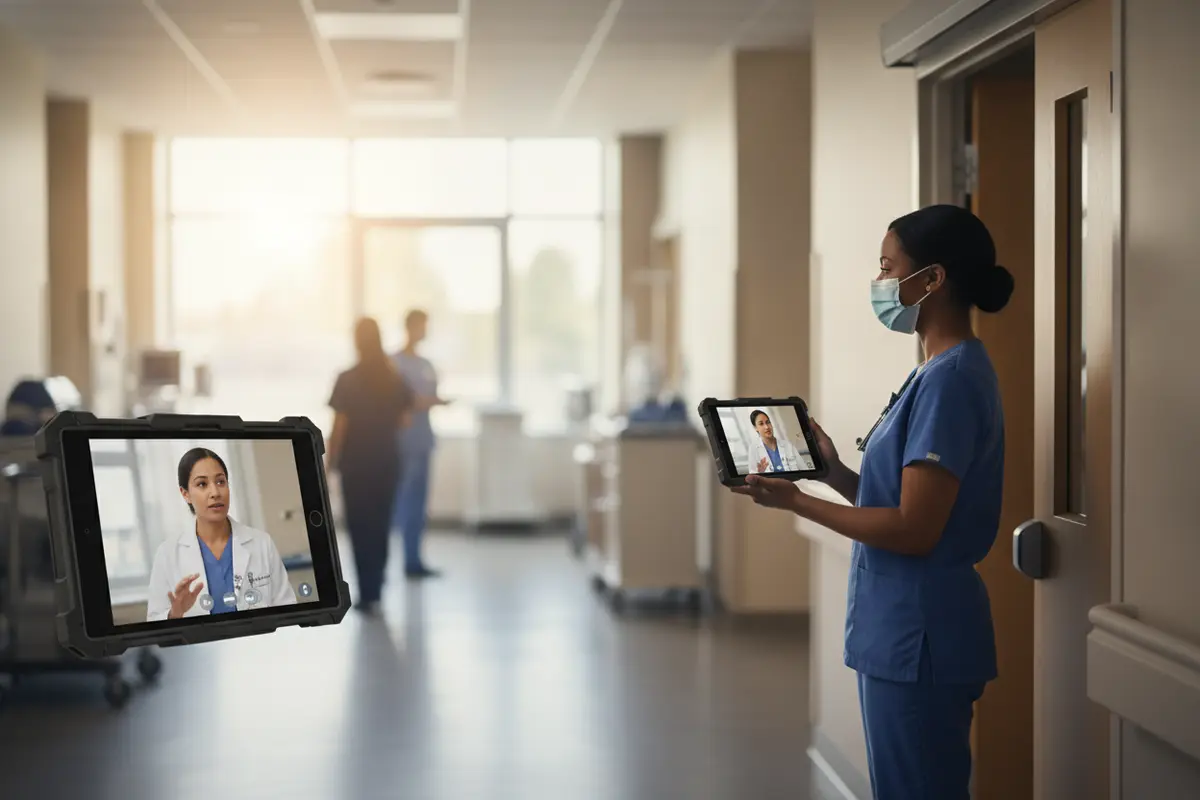
How Do Hospitals Divide Virtual and Bedside Responsibilities?
Role clarity is the central operating decision. A remote nurse may be able to communicate, review information, or coordinate, but a remote connection cannot perform a physical task. The bedside nurse may need to assess the patient, respond to immediate needs, or complete a task that requires presence. These responsibilities should be explicit in policies and training, not left to informal interpretation during a busy shift.
For every selected workflow, write down who initiates the contact, who confirms patient identity, who leads the conversation, what information is reviewed, who records the interaction, and who acts on a concern. State which steps the remote nurse may complete independently and which require direct confirmation from a bedside nurse or another clinician. Define what happens if the patient does not answer, the video connection fails, or the situation changes during the interaction.
A responsibility matrix can expose gaps before launch:
| Workflow point | Virtual nurse | Bedside team | Local decision to document |
|---|---|---|---|
| Prepare the interaction | Review approved information and planned questions | Confirm patient and immediate availability | Who schedules and initiates the contact? |
| Conduct the interaction | Lead only the approved remote portion | Provide physical support or clarification when needed | Which patients and situations are appropriate? |
| Identify a concern | Communicate the concern through the escalation pathway | Assess and respond within assigned responsibilities | What is urgent, and how is a response confirmed? |
| Document and close | Record the assigned portion in the approved record | Verify handoff and complete bedside documentation | Where is the authoritative record, and who closes the task? |
This table is a starting point, not a scope-of-practice template. Nursing leadership, compliance, clinical governance, and relevant professional advisors should adapt it to applicable laws, policies, collective agreements, and institutional responsibilities. Teleray’s hospital telehealth workflow guide offers a related technology-workflow perspective, while its virtual care overview describes the company’s platform context.
What Operating Models Can Hospitals Compare?
There is no single staffing arrangement that fits every hospital. A practical comparison focuses on coverage, patient selection, coordination demands, and the level of remote support the organization can sustain. Local leaders should evaluate an operating model against the workflows and staffing constraints they have actually identified.
| Model | How it is organized | Potential fit to evaluate | Questions to resolve |
|---|---|---|---|
| Unit-aligned remote nurse | A remote nurse supports one unit or a small, defined group of units. | Teams that need close familiarity with unit routines and regular coordination. | How are assignments covered across shifts, breaks, and absences? |
| Centralized nursing hub | A pool of remote nurses supports multiple units using defined routing and prioritization. | Organizations considering shared coverage across locations or departments. | Who triages requests, balances demand, and communicates delays? |
| Task-specific coverage | Remote nursing is limited to a small set of scheduled or clearly defined workflows. | Hospitals that want to test a bounded use case before broader adoption. | How will handoffs and exceptions be handled outside the selected tasks? |
| Hybrid coverage | Unit-based and centralized resources share defined responsibilities. | Organizations with varying needs across units or times of day. | Which team owns each patient interaction and the related documentation? |
These categories describe operational patterns, not validated outcomes. A hospital may combine them, but complexity can also create competing queues and uncertainty over ownership. Before choosing, map a typical shift and a difficult shift. Include peak demand, low staffing, interruptions, patient refusal, connection failure, and a need for immediate in-person attention.
How Should a Hospital Design the Workflow Before Selecting Technology?
Map the workflow from the trigger to documented completion. Include the patient, the remote nurse, bedside staff, charge nurse or supervisor, and any support role involved in resolving technical problems. The map should show both the expected path and the exception path. If a task can stall without a clear owner, the process is not ready for wider use.
- Select one bounded use case. Name the task, patient group, units, hours, and exclusions. Avoid starting with a broad promise to “virtualize nursing.”
- Set eligibility and stop rules. Define when remote interaction is appropriate and when the bedside team should lead or take over. Include patient preference and accessibility needs.
- Assign accountability. Identify who owns each action and who has authority to escalate. Make clear that technology does not alter professional scope or clinical judgment.
- Design the handoff. Decide how staff know an interaction is complete, what information must transfer, and how a concern is acknowledged. Avoid relying on an unverified message or verbal assumption.
- Choose a documentation process. Specify where the record is entered, how duplicate notes are avoided, and which role closes the loop. Confirm the process aligns with hospital policy.
- Test exceptions. Simulate a failed connection, an unavailable bedside nurse, an urgent concern, an incorrect patient match, or a patient who declines. Make sure staff can move to the standard in-person process.
- Train and revise. Orient each role to workflow limits, privacy expectations, escalation, and downtime procedures. Collect frontline feedback and update the process before expanding.
These steps keep the evaluation focused on operational fit rather than a feature checklist alone. Related resources include Teleray’s secure video buyer criteria and pre-install checklist, which can help teams frame technical and readiness questions.
What Should Leaders Assess in Technology, Privacy, and Security?
Technology should support the workflow, not obscure its ownership. Assess the quality and reliability of live communication in the rooms where it will be used, how staff access the system, whether authorized users can connect to the correct patient and room, and what happens when equipment or network access is unavailable. Include practical needs such as audio clarity, privacy controls, accessibility, device placement, cleaning procedures, and technical support responsibilities.
Privacy and security review should be specific to the proposed deployment. Ask what information is transmitted or stored, who can access it, how access is managed, what records are retained, and how the vendor supports the hospital’s security review. Validate claims and contractual terms with the organization’s privacy, security, legal, and procurement teams. A marketing statement is not a substitute for the hospital’s own assessment.
For a Teleray evaluation, leaders can review the company’s security and compliance information and ask how its stated HIPAA and SOC 2 Type II controls apply to the precise service and configuration under review. Where a workflow also involves diagnostic image viewing, distinguish that capability from virtual nursing: the company describes an FDA 510(k)-cleared diagnostic viewer, but that does not mean the FDA endorses a vendor or the nursing workflow. A platform provides technology; it does not provide medical advice or replace clinical judgment.
Assess integration as a workflow question. Can the team reach the information it needs without creating parallel, conflicting records? What manual steps remain? Which system is authoritative for documentation? Hospitals can consult Teleray’s EMR information and EMR/EHR integration guide as starting points, then verify technical fit with their own IT and clinical teams. Do not assume a listed integration removes the need for local configuration, governance, or validation.
How Can Hospitals Evaluate a Pilot?
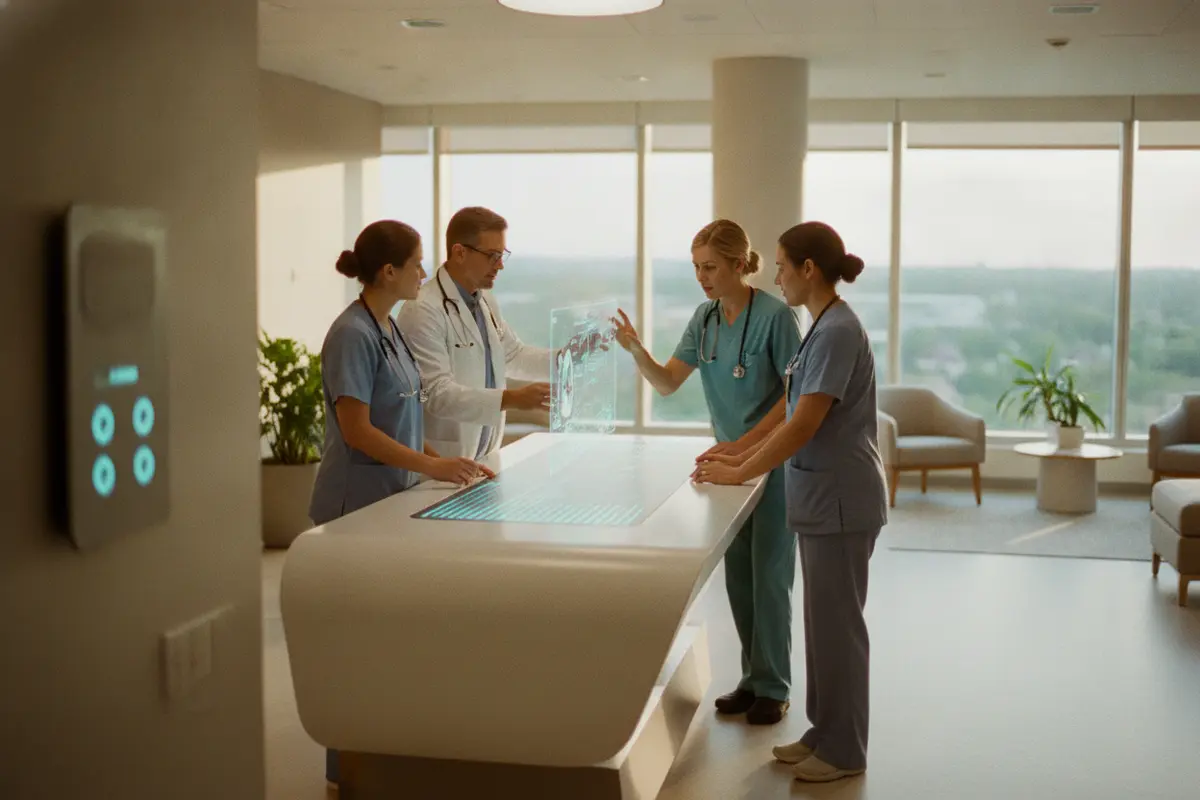
A pilot should answer a small number of operational questions. Set a baseline and define how the hospital will collect information before the workflow begins. Measures should reflect the stated purpose and include both intended benefits and possible burdens. For example, leaders may examine whether the process was completed as designed, how often a bedside handoff was needed, whether connection failures interrupted work, and how nurses experienced workload and role clarity.
Do not treat one measure as proof of overall success. A faster interaction might still create additional documentation, and high usage might not mean the workflow is appropriate for every patient. Pair operational measures with staff feedback, patient experience where suitable, privacy or safety incident review, and records of exceptions. The American Nurses Association’s principles of virtual nursing note the need for ongoing nursing research to measure effects on quality outcomes and inform the practice. That is a reason to make evaluation part of the model, not an afterthought.
Use a staged review: confirm readiness and training; observe the first interactions closely; review exceptions and staff feedback at a set interval; then decide whether to revise, continue, expand, or stop. Keep the decision criteria written down. If leaders change the patient group, hours, tasks, or staffing coverage, they should evaluate whether the original safeguards and measures still apply.
How Does Teleray Fit a Virtual Nursing Evaluation?
Teleray provides virtual care technology, including communication and observation capabilities that may be relevant to hospital teams exploring remote nurse workflows. The appropriate fit depends on the selected use case and how the hospital configures responsibilities, access, documentation, escalation, privacy review, and in-person fallback. A technology platform cannot decide which clinical tasks belong in a virtual workflow; the hospital’s nursing and governance leaders must do that.
Keep the boundary between virtual nursing and imaging clear. Teleray also provides medical imaging software, including DICOM/PACS capabilities, but it does not provide diagnostic reads or staffed radiologists. A hospital assessing a nursing workflow should not assume that imaging functions are required, or that combining systems settles separate clinical, regulatory, or operational questions.
To determine fit, bring a workflow map and responsibility matrix to a product discussion. Ask how the proposed configuration supports the specific room, unit, and staffing model; how access and connection failures are handled; which integrations are relevant; and what information the hospital needs for its privacy and security review. Teams can also consult Teleray’s solutions overview and contact page to discuss the intended use case.
Frequently Asked Questions
Does virtual nursing replace bedside nurses?
No. Virtual nursing is a way to deliver selected nursing support remotely. It does not remove the need for bedside assessment, physical care, or timely in-person response. Each hospital must assign responsibilities and escalation paths for its own workflows.
Which tasks are appropriate for a virtual nurse?
That depends on the organization’s policies, applicable scope rules, patient needs, and the task itself. Hospitals often evaluate communication, coordination, or other defined steps that can be supported remotely, while retaining physical tasks and assessments for staff who are present.
Does a video connection make a workflow safe by itself?
No. Video is a communication tool, not a staffing policy or clinical safeguard on its own. A safe design also needs eligibility rules, role clarity, identity and privacy processes, escalation, documentation, staff training, and a working in-person fallback.
How should hospitals start a virtual nursing program?
Choose one bounded use case, map the workflow, confirm clinical and operational ownership, and test exceptions before expanding. Establish baseline measures and a review process so leaders can revise the model based on actual workflow performance and staff feedback.
Is virtual nursing the same as remote patient monitoring?
Not necessarily. Hospital virtual nursing often concerns remote nurse-to-patient or nurse-to-staff interactions within an inpatient workflow. Remote monitoring can refer to different models and technologies, so teams should define the term and the intended patient-care process rather than assume they are interchangeable.
Hospitals should evaluate virtual nursing as a defined operating model, not a technology shortcut: select the workflow, clarify who owns each step, test exceptions, and use evidence from the local pilot to guide the next decision.