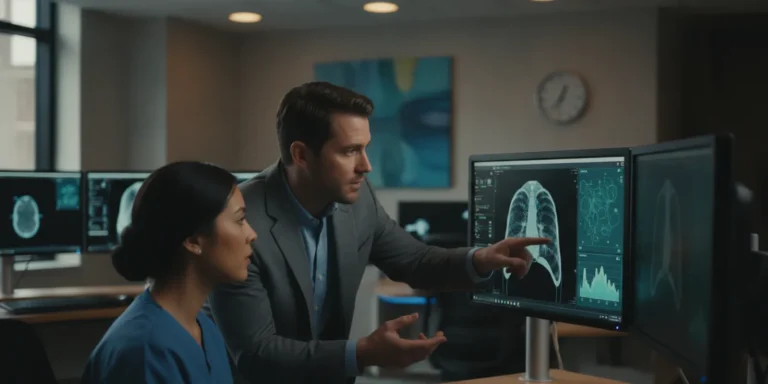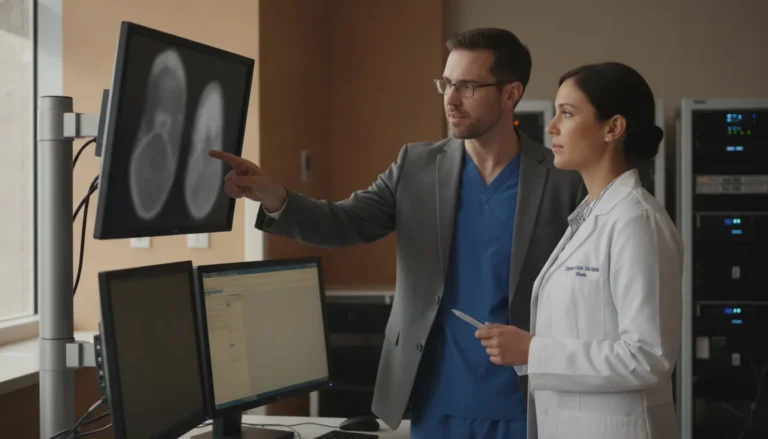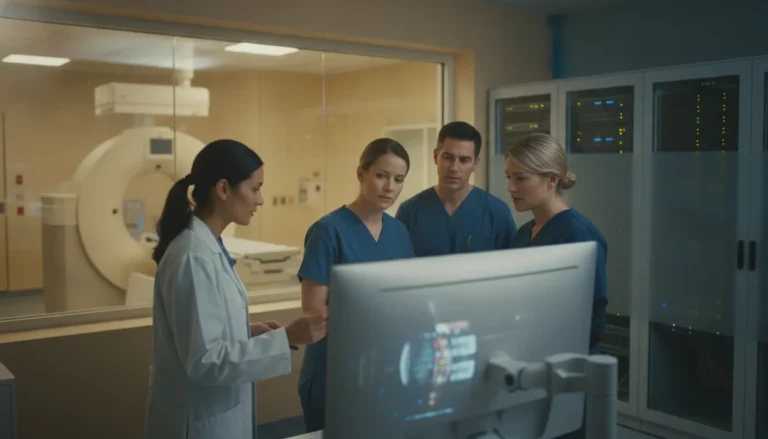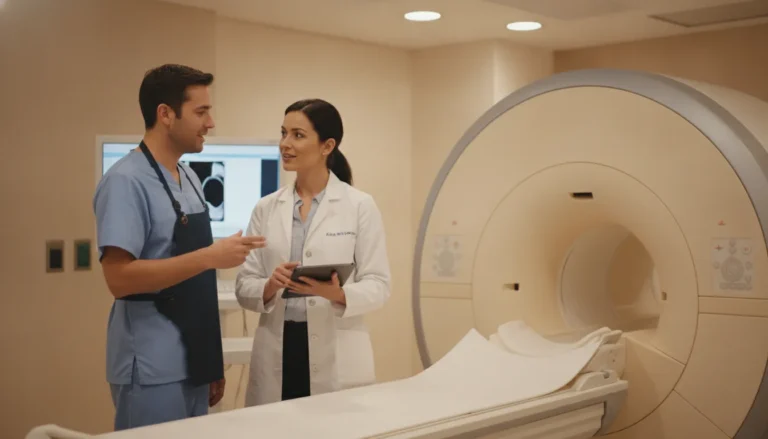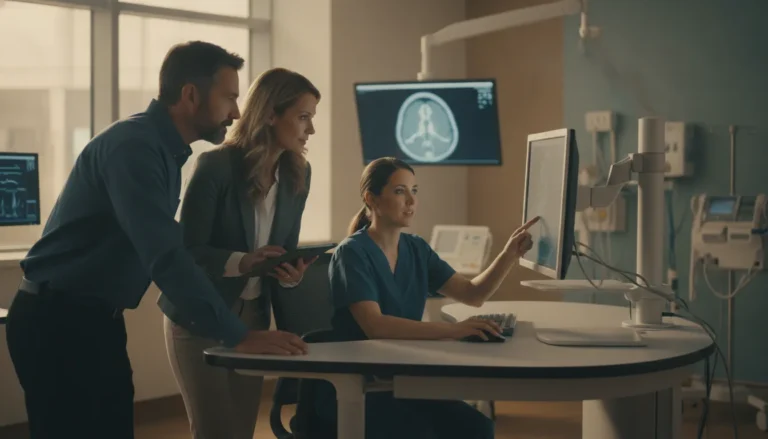
Imaging may be acquired at one facility and reviewed elsewhere. The clinical work and the technology that moves the images must stay distinct. A radiologist working remotely is a physician who interprets medical images and communicates findings through the agreed clinical workflow. A specialist joining a procedure live to observe a modality stream and consult with the local team is doing something different.
A teleradiologist reviews completed imaging studies remotely and reports findings to the appropriate clinical team; live modality collaboration instead supports consultation while an examination is underway. Teleray provides software for imaging workflows and real-time collaboration, not radiology reads or teleradiologists.
For hospital leaders, the practical question is how image access, interpretation, reporting, and escalation fit into the existing workflow, with qualified clinicians retaining responsibility for clinical judgment. Start by tracing what happens to a study from acquisition through review and communication of the report.
What Does a Teleradiologist Do in a Hospital Workflow?
A teleradiologist is a physician who interprets medical images remotely and communicates the results to the care team. The work is clinical, not simply a review of pictures on a screen: the physician considers the study. Its technical quality, relevant clinical information, and any available prior images in the context of the question being asked.
The American Board of Medical Specialties describes diagnostic radiology training as a five-year pathway: one year of clinical training and four years of radiology training. Verify each reader’s qualifications through your credentialing process. (ABMS overview of diagnostic radiology)
From image acquisition to report
Local staff acquire the study. They send it through the facility’s systems, commonly PACS, to the radiologist. The reader confirms the study and available patient context, reviews the images, and prepares a report for the referring clinician. The report returns through the agreed workflow, where the care team can review it and determine next steps. Routing, priorities, and communication depend on hospital protocols and the coverage arrangement.
That sequence relies on clear handoffs. The facility is responsible for accurate patient and study information, appropriate image transfer, and a defined route for reports and urgent communications. The radiologist is responsible for professional interpretation and documentation within the scope of the assignment. Hospital policy should identify how questions, amended reports, and time-sensitive findings are communicated and acknowledged. A software notification alone should not be treated as proof that a clinician has received or acted on a message.
Clinical accountability stays with clinicians
Remote access changes where the radiologist works, not who makes the interpretation. The teleradiologist remains a physician responsible for the interpretation and report, while the ordering or treating team remains responsible for integrating that report with the patient’s broader care. Hospitals should define credentialing, privileges, escalation contacts, documentation, and quality-review procedures before relying on a remote workflow. Applicable licensing and practice requirements can vary, so compliance teams should confirm the rules for the jurisdictions involved.
Technology supports image access and exchange; it does not provide radiology reads or supply the physician. For a separate look at software and platform selection, see Teleray’s teleradiology platform capabilities guide. This section focuses on the clinician’s role and accountability, rather than repeating that buyer guide.
How Does Remote Interpretation Differ From Live Modality Collaboration?
The key difference is timing and purpose. Remote interpretation concerns images from an examination that has already been acquired. Live modality collaboration happens while a local clinician or technologist is carrying out an examination or procedure. With a remote specialist viewing the stream and communicating in real time.
In a remote-reading workflow, completed image studies are transmitted through imaging systems such as PACS to a radiologist working elsewhere. The radiologist reviews the study and documents an interpretation for the referring clinical team. The remote location changes where the physician works, not who is responsible for interpreting the images or communicating findings. A teleradiologist is a qualified clinician performing that interpretation; the software used to move or display images does not become the reader.
Live modality collaboration serves a different operational need. A remote specialist can view a live stream from a modality, such as ultrasound or MRI, and consult with the local team while the examination is underway. The person at the facility remains responsible for operating the equipment and providing care. The exchange may support discussion of image acquisition or technique in the moment, rather than producing the formal interpretation of a completed study.
Teleray Live supports real-time modality streaming and video collaboration. This capability connects people and images across locations, but it does not make Teleray a teleradiology provider: Teleray supplies software, not radiologists or radiology reads. A hospital that needs an official interpretation still needs its own qualified radiologist or a separately contracted reading service and defined reporting workflow.
These workflows can complement one another. A live consultation may occur during image acquisition, after which the completed study can enter the facility’s normal PACS and interpretation process. They should not be treated as interchangeable, however. When evaluating a system, clarify whether the need is access to a remote reader for completed studies, real-time consultation during a procedure. Or both, and define who operates the modality, interprets the study, documents the result, and communicates with the care team.
For an example of live modality collaboration, see how remote viewing can connect a specialist with the team performing an MRI locally.
What Technology and Safeguards Support Remote Image Interpretation?
A remote reading workflow depends on more than moving image files. Leaders should assess how studies arrive, whether the diagnostic display fits the intended use, who can access patient information, and what happens when an interface or connection fails. Use the questions below to compare systems against your own clinical, technical, and governance requirements.
| Evaluation area | Questions for hospital leaders | Teleray product details |
|---|---|---|
| DICOM and PACS | Can the system exchange studies with the hospital’s PACS? Which modalities and study types are supported, and how are image integrity and patient identifiers checked? | Supports DICOM 3.0 and CT, MRI, X-ray, ultrasound, mammography, fluoroscopy, and PET/CT. |
| Diagnostic viewer and workstation | Is the viewer appropriate for the intended diagnostic use? What display, workstation, and local validation requirements apply? | The diagnostic viewer is FDA 510(k)-cleared for primary diagnostic interpretation. Confirm that the proposed setup meets the organization’s requirements; clearance is not FDA endorsement of a vendor or a replacement for clinician judgment. |
| Routing and worklist | Can studies be routed to the right reader or destination? How are priorities, exceptions, and incomplete transfers surfaced? | Includes routing and modality worklist capabilities. Map these to local assignment and escalation procedures. |
| Security and access | How are users authenticated and authorized? What protections apply to stored and transmitted data, and what evidence supports the organization’s compliance review? | Teleray describes HIPAA compliance and SOC 2 Type II, AES-256 encryption at rest, and TLS 1.3 in transit. These product attributes do not guarantee the security or compliance of an entire hospital workflow. |
| Integration | Which PACS, RIS, identity, and reporting interfaces are required? Who tests them, and how are failures detected and resolved? | Validate compatibility and interface behavior with the hospital’s actual environment before relying on a workflow. |
| Resilience and support | What happens during downtime or network interruption? Is there a documented recovery path, support route, and process for reconciling delayed studies? | Define and test these expectations with the vendor and local operations team; do not assume resilience from feature lists alone. |
Diagnostic viewing also requires attention to the full workstation and workflow, not only the viewer’s feature set. Review diagnostic DICOM viewing requirements as part of that assessment, then validate the chosen configuration with radiology, IT, security, and compliance stakeholders.
How Should Leaders Plan Coverage, Handoffs, and Accountability?
A remote-reading arrangement works best when expectations are explicit before the first study is routed. Treat coverage as a clinical operations design decision: define who is responsible at each point. How exceptions are handled, and how the local team knows a report or escalation has been received.
- Define the service scope and coverage windows. List the modalities, study types, locations, and hours included, along with exclusions and backup arrangements. Decide whether coverage is for scheduled work, overflow, after-hours interpretation, or a defined combination. Peer-reviewed teleradiology guidance can help frame questions about organizational modes, technical requirements, documentation, and responsibilities, but it is not a substitute for local policy or legal advice (teleradiology practice guidelines).
- Verify the reader and applicable requirements. Establish how the assigned radiologist’s qualifications and relevant subspecialty experience will be confirmed, and identify professional and organizational accountability for each interpretation. Confirm credentialing, privileging, and licensure requirements with medical staff and compliance teams. The Federation of State Medical Boards describes variation among jurisdictional telemedicine policies; ask counsel or compliance staff to check what applies to the specific arrangement (FSMB state policy overview).
- Make routing and priority definitions operational. Document which studies enter the remote queue, what information and prior images should accompany them, and how local protocols assign routine, urgent, or emergent priorities. Specify who can change a priority and what happens when a study is incomplete, misrouted, or cannot be opened. Define service expectations locally rather than relying on a generic turnaround promise.
- Close the report and escalation loop. Decide where the final report is returned, how receipt is confirmed, and who is responsible for communicating a time-sensitive finding to the treating team. Provide a direct escalation path for failed delivery, unavailable readers, or unresolved questions. Record communication and follow-up according to facility policy.
- Review quality and communication routinely. Assign an owner to monitor workflow exceptions, missing information, report-routing failures, and escalation documentation. Agree on how concerns are reviewed, corrected, and shared with the remote reader and local staff. Use findings to refine protocols while keeping clinical interpretation and decisions with qualified professionals.
These steps give leaders a practical basis for a coverage agreement and handoff checklist. Local clinical governance should approve the final workflow before it goes live.
What Should a Hospital Evaluate Before Adopting a Teleradiologist Workflow?
Start with the work the service is expected to support, rather than with a feature list. Define which studies, locations, hours, and clinical teams are in scope, and distinguish interpretation of completed examinations from real-time consultation during image acquisition. That boundary affects staffing, routing, escalation, and the technology required.
Before a pilot, bring radiology, clinical operations, IT, privacy, and compliance stakeholders together to map the current path from image acquisition to final report. Identify where studies enter the system, who assigns priority, how the interpreting radiologist receives relevant context, where the report returns, and who is responsible for communicating urgent findings. Write down ownership for each handoff, including what happens when a study is incomplete, a connection drops, or the expected reader is unavailable.
Test the workflow with representative cases
Use a bounded pilot with the modalities, shifts, locations, and user roles that reflect the intended operating model. Agree in advance on practical measures, then compare them with the hospital’s own baseline. Possible measures include time from image availability to assignment, the frequency of missing information or rerouting, report-return completion, escalation acknowledgement, and staff-reported usability. Set thresholds based on local policy and service needs; do not assume a vendor’s general benchmark will fit every department.
Observe the actual work, not only a successful demonstration. Can authorized users find the right study and view it on the intended workstation? Do images and patient context move through the hospital’s PACS, RIS, or other systems as expected? Are display conditions and viewer functions appropriate for the intended diagnostic use? Confirm how the workflow behaves with poor connectivity, delayed transfers, duplicate studies, and downtime, and ensure staff know the fallback process.
Confirm governance and operational ownership
Document who may access images, how access is reviewed, what audit records are available, how incidents are reported, and who maintains integrations. Have compliance or legal counsel verify applicable professional licensure and jurisdictional requirements for the clinicians and patients involved. Establish who reviews pilot results and can pause or revise the workflow if safety, usability, or operational concerns emerge.
Technology should fit the agreed clinical process, while qualified clinicians retain responsibility for interpretation and judgment. For a broader view of specialist collaboration in imaging workflows, consider how imaging exchange and consultation fit alongside the hospital’s existing operations.
Where Does Teleray Fit in a Teleradiologist Workflow?
Teleray fits on the technology side of the workflow. It provides software for imaging access, exchange, and collaboration; it is not a radiology-reading service and does not employ or supply teleradiologists. A qualified radiologist remains responsible for interpreting images and communicating findings through the provider’s clinical process.
For completed studies, Teleray describes support for DICOM 3.0 across modalities including CT, MRI, X-ray, ultrasound, mammography, fluoroscopy, and PET/CT. Its listed capabilities include DICOM routing and modality worklist functions. These tools can form part of a site’s image-handling workflow. But leaders should confirm how they fit with their own PACS, worklists, identity controls, and reporting steps before adoption. The right configuration depends on the facility’s systems and operating requirements.
Teleray also describes secure image exchange using customer-specific storage silos, AES-256 encryption at rest, and TLS 1.3 in transit, alongside HIPAA compliance and SOC 2 Type II. Those are platform attributes, not a guarantee that every connected system or end-to-end workflow meets an organization’s requirements. IT and compliance teams should review access, data movement, retention, and responsibilities across the full environment.
A separate use case is live modality collaboration. Teleray Live supports real-time streams from modalities such as ultrasound, fluoroscopy, MRI, and CT. With video collaboration so a remote specialist can view imaging while local staff conduct the procedure. That is different from interpreting a completed exam and should not be presented as a radiology read. Learn more about live modality collaboration.
In practice, a hospital can assess Teleray as an enabling layer for image movement, viewing. And remote collaboration, while keeping clinical interpretation, staffing, and reporting accountability with its chosen providers and clinicians. Validate the intended workflow with radiology, operations, IT, and compliance stakeholders.
Frequently Asked Questions
What does a teleradiologist do?
A teleradiologist is a radiologist who interprets medical images remotely and communicates findings through the agreed clinical workflow. The American Board of Medical Specialties describes radiologists as physicians who use imaging methods to diagnose and manage patients (ABMS). The treating team remains responsible for connecting the report with the patient’s care.
How is remote interpretation different from live modality consultation?
Remote interpretation generally concerns images from a completed examination, reviewed by a radiologist who sends a report to the referring clinician. Live modality consultation happens during an examination or procedure, when a remote specialist can view a stream and collaborate with the local clinical team. Teleray describes Teleray Live as supporting real-time streams from modalities including ultrasound, fluoroscopy, MRI, and CT (Teleray Live modality collaboration). That software enables communication; it does not provide the radiology read.
What technology supports remote image interpretation?
Hospitals typically assess image transfer and storage through PACS, compatible DICOM workflows, study routing, and a diagnostic viewer and workstation suited to clinical use. Teleray lists DICOM 3.0, routing, and modality worklist functions among its platform capabilities (Teleray platform capabilities). Confirm that the proposed setup fits your own modalities, systems, access controls, and support requirements.
What should a hospital verify before using a teleradiology workflow?
Define who interprets studies, how coverage and priority are assigned, where reports go, and how urgent findings are escalated and documented. Confirm reader qualifications and applicable licensing requirements with compliance or legal counsel, since telemedicine rules can vary by jurisdiction; the FSMB provides an overview of state policies (FSMB overview). Test the handoffs with the people who will use them before relying on the workflow.
Make Remote Imaging Workflows Clear and Accountable
A teleradiologist workflow succeeds when the physician’s interpretation, the technology moving images, and the local team’s responsibilities are clearly defined. Remote reading of completed studies and live modality consultation solve different workflow needs, but both depend on reliable image access, clear handoffs, and accountable communication. Teleray provides software for imaging and collaboration, not radiology reads. Review how these capabilities may fit your environment with a Schedule a demo.