Telehealth vs telemedicine is not simply a choice between two names for a video visit. For healthcare leaders, the distinction helps define what a program includes, which teams need access, what information must move between systems, and how a platform should support clinical accountability. Telehealth is the broader category. Telemedicine is a clinical subset focused on delivering medical, diagnostic, or treatment-related services across distance. The terms overlap, but they are not interchangeable in every planning conversation.
Telehealth vs telemedicine: What is the difference?
Telehealth covers a wide range of remote healthcare activities, including clinical care, patient and professional education, administration, public health, and care-team coordination. Telemedicine is narrower. It refers to using telecommunications technology to provide medical, diagnostic, or treatment-related services when the relevant people are in different locations.
The cleanest way to remember the relationship is this: telemedicine fits inside telehealth, but not every telehealth activity is telemedicine. A remote specialist consultation is telemedicine. A virtual nursing check-in can be telehealth and may also be part of a clinical telemedicine program. A staff education session delivered online is telehealth, but it is not itself a medical service.
What does telehealth mean for a healthcare organization?
Telehealth is an umbrella term for using electronic information and telecommunications technologies to support healthcare work across distance. The work may involve a patient, clinician, nurse, specialist, educator, administrator, or public-health team. The technology can include interactive audio and video, secure messaging, electronic records, streaming media, image exchange, and connected clinical systems.
For leaders, the value of the broader term is operational. It allows an organization to describe the full connected model rather than one encounter type. A health system may use telehealth to support virtual rounding, telenursing, telesitting, specialist collaboration, professional education, secure image exchange, and administrative coordination. Each use case has its own participants, data requirements, governance controls, and escalation paths.
Teleray’s virtual care platform illustrates this wider operating model. Its capabilities are designed for use cases such as telenursing, telesitting, tele-ICU support, patient monitoring, and communication with care teams. This does not mean technology makes clinical decisions. It means a healthcare organization can give authorized teams a secure way to communicate, observe, share information, and coordinate work.
What does telemedicine mean in healthcare?
Telemedicine is the delivery of medical, diagnostic, or treatment-related services through telecommunications technology when distance separates the participants. The interaction can be patient-to-clinician, clinician-to-clinician, or clinician-to-specialist. It can be synchronous, such as a live consultation, or asynchronous, such as a diagnostic image sent for later review.
The term is therefore broader than a consumer video appointment, but narrower than telehealth. The defining question is whether the remote activity serves a medical, diagnostic, or treatment purpose. The American Academy of Family Physicians overview describes telemedicine as the practice of medicine using telecommunications technologies for medical, diagnostic, and treatment-related services. The National Library of Medicine similarly describes telemedicine as remote medical practice supported by electronic interfaces.
These definitions matter because they keep program design grounded in the work being performed. A platform used for telemedicine must support more than a conversation. Depending on the use case, it may need clinical context, participant identity, secure exchange, imaging access, documentation, interoperability, and clear responsibility for the care decision.
Telehealth and telemedicine compared at a glance
The following comparison gives healthcare leaders a practical starting point. Actual program definitions can vary by jurisdiction, payer, specialty, and organizational policy, so the table should guide planning rather than replace legal or compliance review. The American Academy of Family Physicians overview is a useful reference for the broader distinction and standards-of-care context.
| Question | Telehealth | Telemedicine |
|---|---|---|
| Scope | Broad category covering clinical and nonclinical remote healthcare activities. | Clinical subset involving medical, diagnostic, or treatment-related services. |
| Typical participants | Patients, clinicians, nurses, specialists, educators, administrators, and public-health teams. | Patients, clinicians, nurses, specialists, and other professionals involved in medical care. |
| Examples | Virtual nursing, telesitting, education, care coordination, secure image exchange, and virtual visits. | Remote consultation, tele-ICU support, diagnostic image review, and treatment-related follow-up. |
| Technology needs | Communication, scheduling, information exchange, monitoring, and workflow coordination. | Clinical context, secure communication, diagnostic information, documentation, and interoperability. |
| Primary planning question | How can the organization safely coordinate people, information, and care work across distance? | How can authorized professionals deliver or support a medical service across distance? |
Where do virtual visits fit?
A virtual visit is a delivery format, not a complete definition of telehealth. When a patient and clinician meet through live audio and video for a medical consultation, the encounter is telemedicine. It is also telehealth because telemedicine belongs within the broader telehealth category.
In a hospital or health system, the workflow may be more complex than a one-to-one call. A nurse may prepare the patient, a local team may collect information, a remote specialist may participate, and the encounter may need to connect with the EMR. A virtual visit platform should therefore be evaluated according to the surrounding workflow, not only its camera and microphone features.
Leaders should ask whether the platform supports authorized access from the right devices, preserves the necessary patient context, connects with the organization’s existing systems, and gives the care team a dependable way to document or hand off work. Teleray supports integrations with major EMR systems and provides virtual care capabilities that can be used on desktop, tablet, laptop, or mobile devices. The correct configuration still depends on the organization’s governance and clinical processes.
How do telenursing, telesitting, and remote monitoring fit?
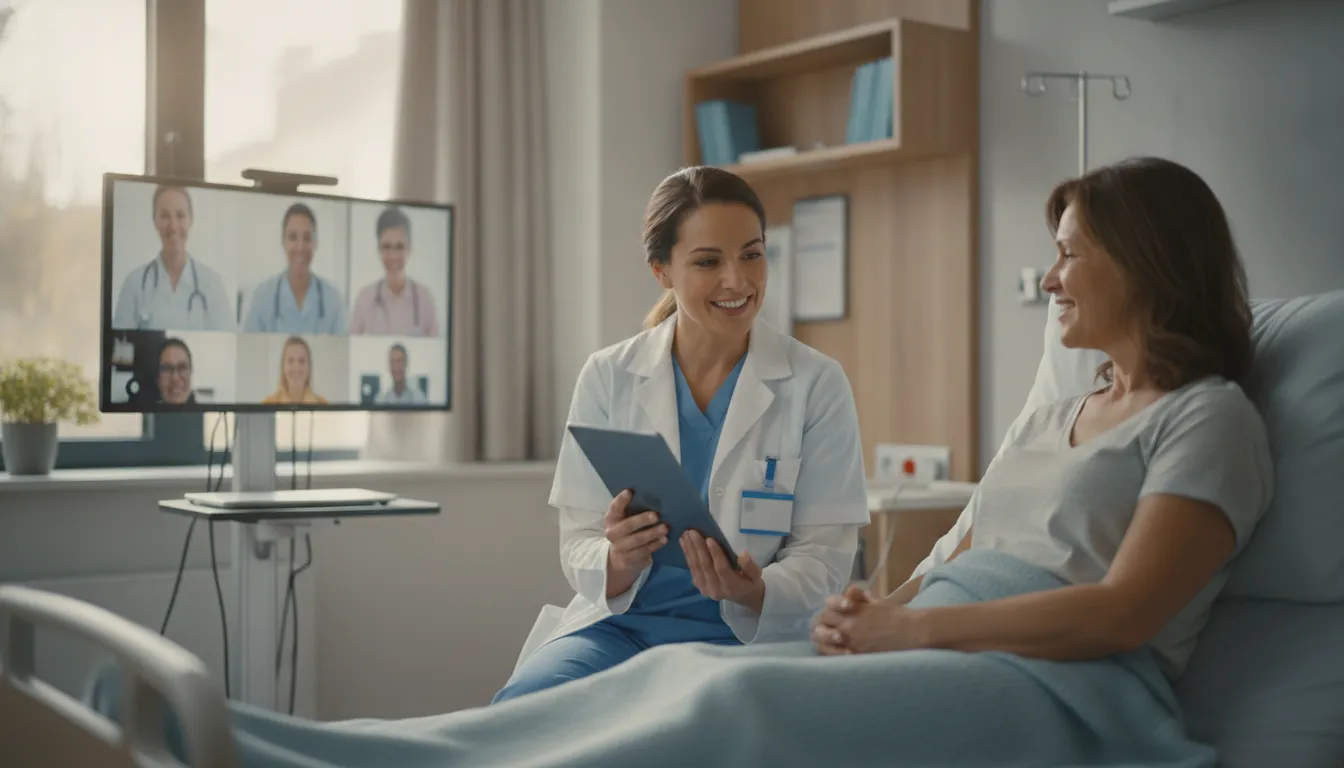
Telenursing and telesitting are telehealth use cases that show why the broader term matters. A remote nurse may communicate with and observe a patient, support local staff, or participate in admissions, discharge, rounding, or consultation workflows. A telesitter may help a care team maintain virtual observation of a patient according to the organization’s policies and escalation procedures.
These activities may be clinical in context, but they are not all the same as a physician telemedicine visit. Their participants, objectives, alerts, documentation, and response protocols can differ. A platform evaluation that asks only whether a vendor supports video visits may miss the requirements for patient observation, multi-room monitoring, two-way communication, privacy controls, and coordination with nurse call or other hospital systems.
Remote monitoring also needs a precise definition. In healthcare generally, the phrase can refer to several models, including device-generated data, staff observation, or remote clinical review. For Teleray, the relevant model centers on telenursing, telesitting, patient interaction, and care-team observation, rather than treating consumer devices in the home as the default example. This distinction keeps the technology discussion aligned with the operational problem a hospital is trying to solve.
Telehealth can also include AI-enabled alerts or monitoring support. Those tools may help authorized teams notice events and coordinate a response, but they do not replace clinical judgment. Program owners should define who reviews an alert, what action is required, how the event is recorded, and how a patient or local care team receives follow-up.
Where does live imaging collaboration fit?
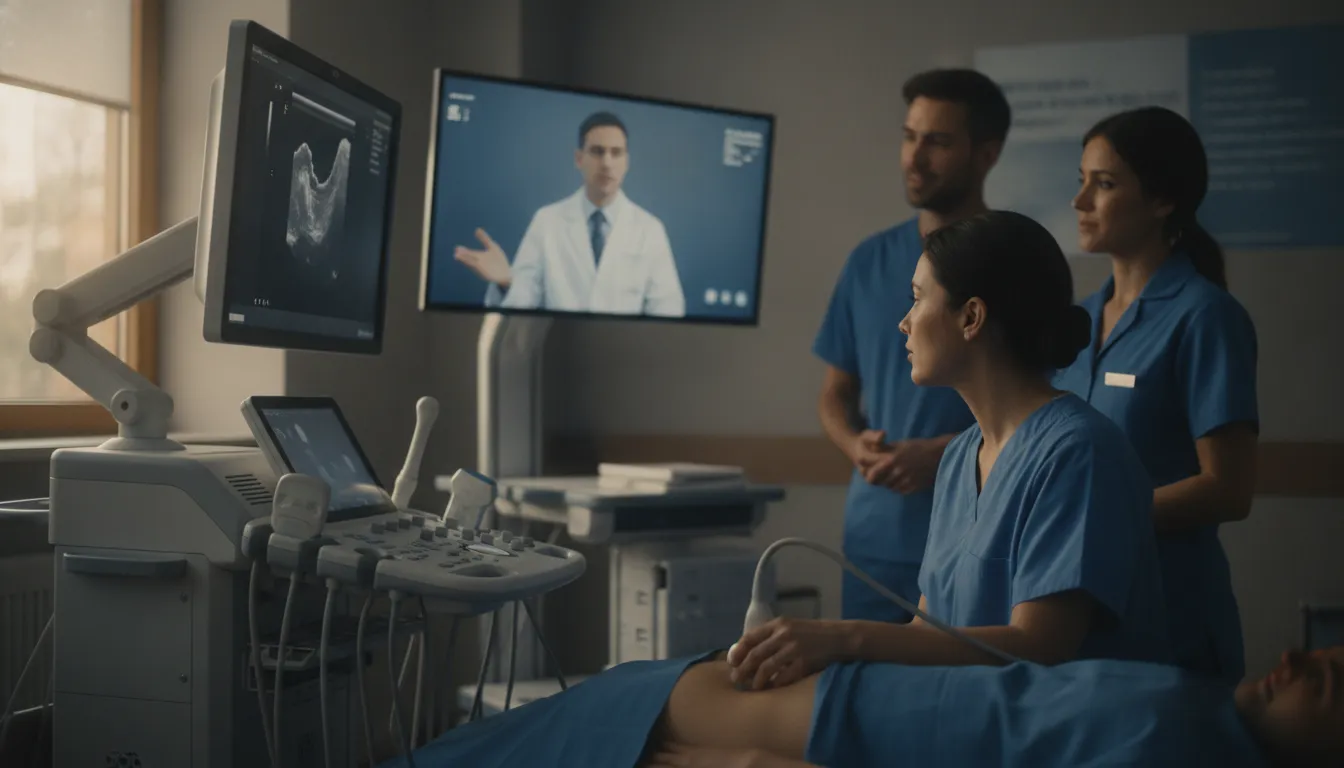
Live imaging collaboration is another example of a telehealth capability that can also support telemedicine. When a specialist views a live modality from another location, communicates with the local technologist, helps guide image acquisition, and interacts with the patient in real time, the activity supports a remote clinical or diagnostic service. It is more than a generic video call because the imaging workflow and clinical purpose are central to the interaction.
Teleray Live is designed around this kind of remote modality collaboration. It can connect a specialist with a local team during work involving modalities such as ultrasound, CT, MRI, fluoroscopy, or other equipment with a video output. The remote specialist can see the procedure context, communicate with the local team, and help the team work toward useful images while the patient and local staff remain involved.
This use case may include live streaming during an examination and DICOM file transfer or study sharing after the examination. Those are related but different workflow moments. The live interaction supports real-time collaboration. The DICOM workflow supports later access, review, exchange, and storage. Healthcare leaders should make sure a platform can represent both without confusing live collaboration with final diagnostic interpretation or independent clinical decision-making.
For organizations evaluating this capability, Teleray’s telehealth for modalities page provides a focused overview. Its secure image exchange and storage capabilities address a different but connected need: moving and managing imaging information after capture.
Why does the terminology matter for healthcare leaders?
Terminology affects scope. Calling a program telehealth may signal that it includes more than patient visits. Calling a program telemedicine may signal a focus on remote medical, diagnostic, or treatment services. Neither label makes a program compliant or clinically appropriate, but the label can influence the requirements that teams write into a plan, procurement document, or governance policy.
Precise language helps leaders align five parts of an enterprise program:
- People: Identify whether the workflow involves patients, nurses, physicians, radiologists, technologists, educators, administrators, or multiple groups.
- Purpose: State whether the activity is clinical care, diagnosis, treatment support, observation, education, administration, or coordination.
- Information: Define whether the workflow needs conversation, patient context, images, DICOM studies, alerts, records, or other data.
- Responsibility: Specify who owns clinical judgment, who responds to alerts, and who documents the interaction.
- Integration: Identify the EMR, PACS, modality, nurse call, identity, and security connections required for the work to fit the existing environment.
It also reduces the risk of buying a narrow video tool for a broader workflow. A telehealth program may require virtual care, imaging, AI monitoring, and interoperability in one operating model. Teleray positions its platform around this convergence, with HIPAA compliance, SOC 2 Type II, proprietary peer-to-peer encryption, 250+ EMR integrations, and an FDA 510(k)-cleared diagnostic viewing capability described in its company materials. Leaders should confirm the exact configuration, scope, and regulatory requirements for their own use case during evaluation.
How should leaders evaluate a platform using these definitions?
Start with the work, not the label. Ask each stakeholder to describe the remote activity in plain language, then map that activity to the people, purpose, information, responsibility, and integration requirements above. This approach prevents a broad term such as telehealth from hiding a missing capability, and it prevents a narrow term such as telemedicine from excluding the operational work that makes clinical care possible.
1. Separate encounter types from platform capabilities
List the use cases separately. A virtual visit, a telenursing session, a telesitting workflow, a live ultrasound collaboration session, a store-and-forward image review, and an EMR notification may all use the same platform, but they should not be treated as one identical workflow.
2. Map synchronous and asynchronous work
Identify what must happen live and what can happen later. Live audio and video may be essential during a specialist consultation or modality examination. Secure image exchange and diagnostic review may occur after the session. The platform should support the timing and information flow of each activity without forcing every task into a video appointment.
3. Define governance and security requirements
Confirm HIPAA safeguards, access controls, auditability, data handling, and the organization’s Business Associate Agreement process. Review SOC 2 Type II evidence and security architecture where applicable. For diagnostic viewing, confirm the relevant FDA clearance and intended use. These checks belong in procurement and compliance review, not in marketing shorthand.
4. Test interoperability in the real workflow
Ask how the platform connects to the EMR, PACS, modalities, identity systems, and existing hospital equipment. Teleray’s EMR integration resources describe connections across major systems. The important test is whether an authorized user can move from the right patient and study context to the right remote workflow without creating avoidable duplicate entry or disconnected records.
5. Define success without promising clinical outcomes
Measure operational indicators such as participation, response time, workflow completion, documentation quality, system availability, and appropriate escalation. Do not assume that a technology platform guarantees a clinical result. The care model, staffing, training, governance, and clinical judgment remain essential.
Frequently Asked Questions
Is telehealth the same as telemedicine?
No. Telehealth is the broader category of remote healthcare activities. Telemedicine is a clinical subset involving medical, diagnostic, or treatment-related services delivered across distance.
Is a virtual visit telehealth or telemedicine?
It can be both. A live medical consultation is telemedicine, and telemedicine fits within telehealth. A nonclinical education or administrative session may be telehealth without being telemedicine.
Are telenursing and telesitting telemedicine?
They are telehealth use cases. Whether a specific activity is classified as telemedicine depends on its purpose, participants, clinical role, and applicable organizational or jurisdictional definitions.
Is remote imaging collaboration telehealth?
Yes. A remote specialist collaborating with a local imaging team is a telehealth activity. When the purpose is medical or diagnostic, it can also fall within telemedicine.
What should a hospital ask when evaluating a telehealth platform?
Ask which people and workflows it supports, what information must move, how live and asynchronous work connect, how it integrates with the EMR and imaging environment, and how security, access, documentation, and clinical responsibility are governed.
Conclusion
The practical difference in telehealth vs telemedicine is scope. Telehealth describes the larger connected healthcare environment. Telemedicine describes remote medical, diagnostic, and treatment-related services within that environment. For healthcare leaders, the best platform decision follows from precise definitions, clear workflow boundaries, secure interoperability, and accountable clinical governance.
TeleRay brings virtual care, imaging collaboration, secure image exchange, EMR integration, and AI-enabled monitoring into one healthcare technology platform. To discuss how the terminology maps to your organization’s workflows, contact the TeleRay team.